.jpg)
A cooling tower is a specialized heat exchanger in which air and water are brought into direct contact with each other in order to reduce the water’s temperature. As this occurs, a small volume of water is evaporated, reducing the temperature of the water being circulated through the tower.
Water, which has been heated by an industrial process or in an air-conditioning condenser, is pumped to the cooling tower through pipes. The water sprays through nozzles onto banks of material called “fill,” which slows the flow of water through the cooling tower, and exposes as much water surface area as possible for maximum air-water contact. As the water flows through the cooling tower, it is exposed to air, which is being pulled through the tower by the electric motor-driven fan.
When the water and air meet, a small amount of water is evaporated, creating a cooling action. The cooled water is then pumped back to the condenser or process equipment where it absorbs heat. It will then be pumped back to the cooling tower to be cooled once again
- Lower power consumption (up to 50%)
- Occupies 30% lower cross-sectional space
- Non-clogging fills with 15-20 years of life
- Non-clogging nozzles for uniform water spread
- No gearbox is needed for fans upto 3 m
- No metal components are used in the tower structure
- We use fire retardant materials as MOC
- Lowest drift loss (0.005%)
TYPE OF COOLING TOWER
Crossflow Cooling Towers:
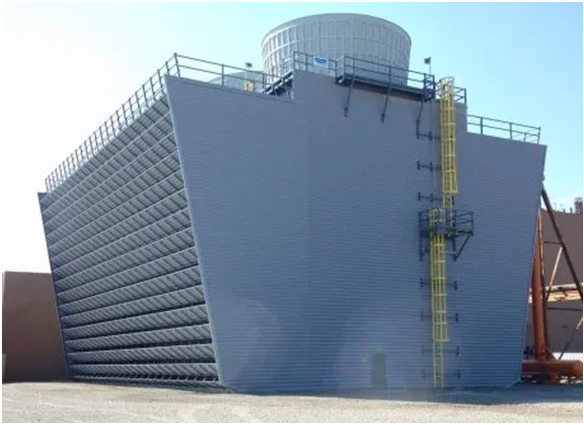
In crossflow cooling towers the water flows vertically through the fill while the air flows horizontally, across the flow of the falling water. Because of this, air does not have to pass through the distribution system, permitting the use of gravity flow hot water distribution basins mounted at the top of the unit above the fill. These basins are universally applied on all crossflow towers.
Counterflow Cooling Towers:
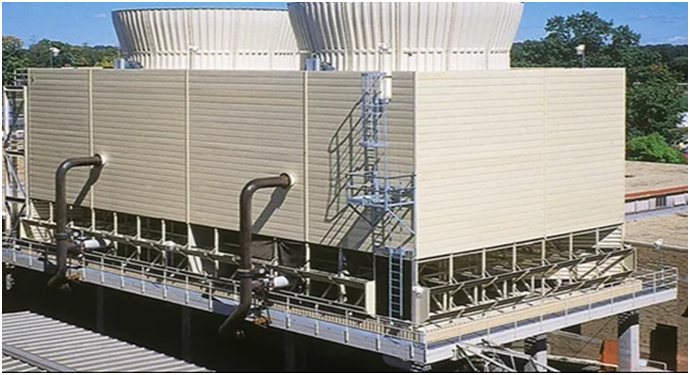
Counterflow cooling towers are designed so that air flows vertically upward, counter to the flow of falling water in the fill. Because of this vertical airflow, it is not possible to use the open, gravity-flow basins typical in crossflow designs. Instead, counterflow towers use pressurized, pipe-type spray systems to spray water onto the top of the fill. Since air must be able to pass through the spray system, the pipes and nozzles must be farther apart so as not to restrict airflow.